A quilt is not a textile purchase — it is a fill-weight decision. Get the fill wrong and the product is either a duvet or a pancake, and the difference is grams, not design.
A quilt is a layered textile assembly: a shell fabric, a filling material, and a quilting stitch pattern that fixes the filling in place so it cannot migrate. In commercial sourcing the three variables that decide cost and performance are fill weight (grams per square metre), fill material, and quilting stitch density. Everything else — colour, print, packaging — sits on top of those three.
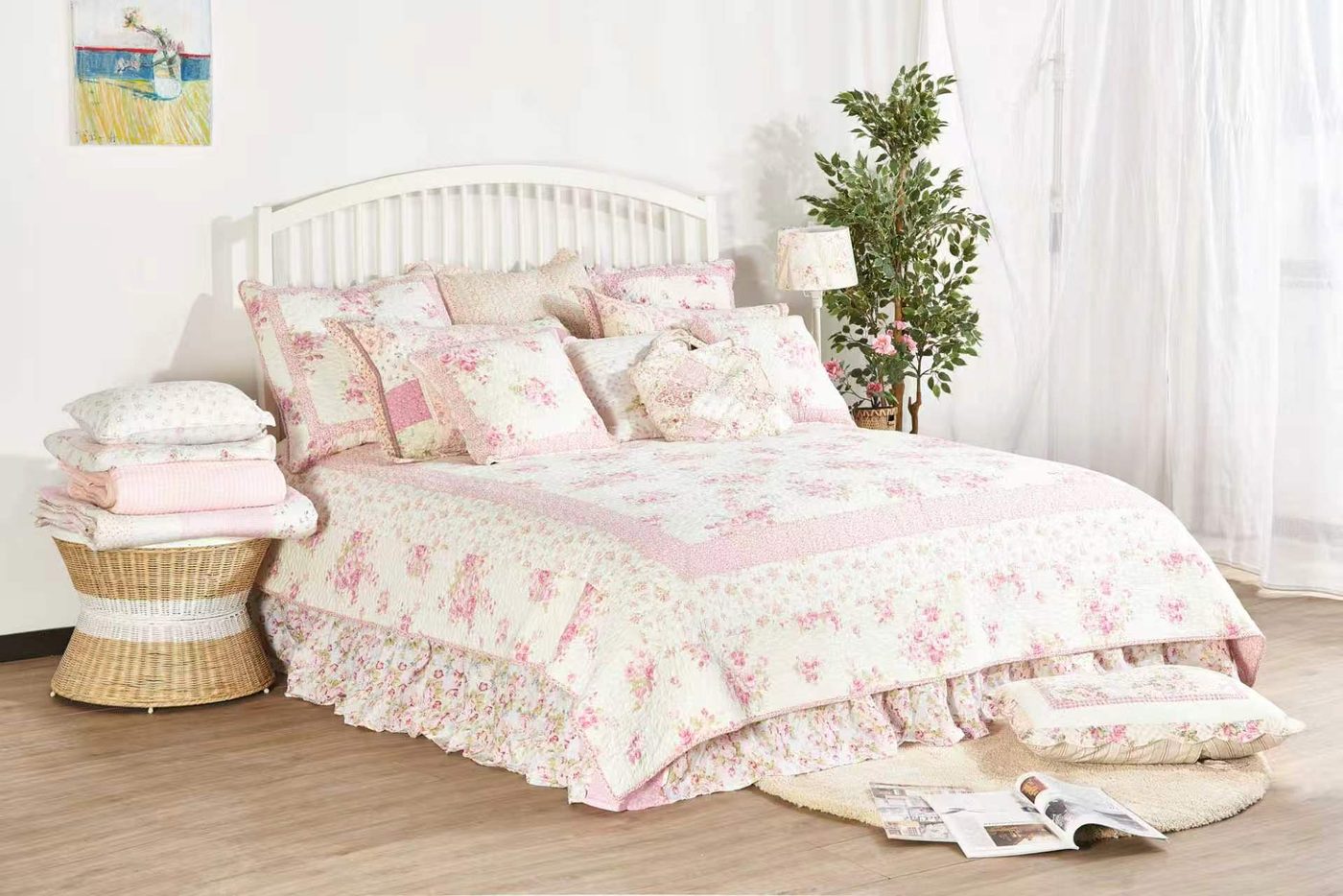
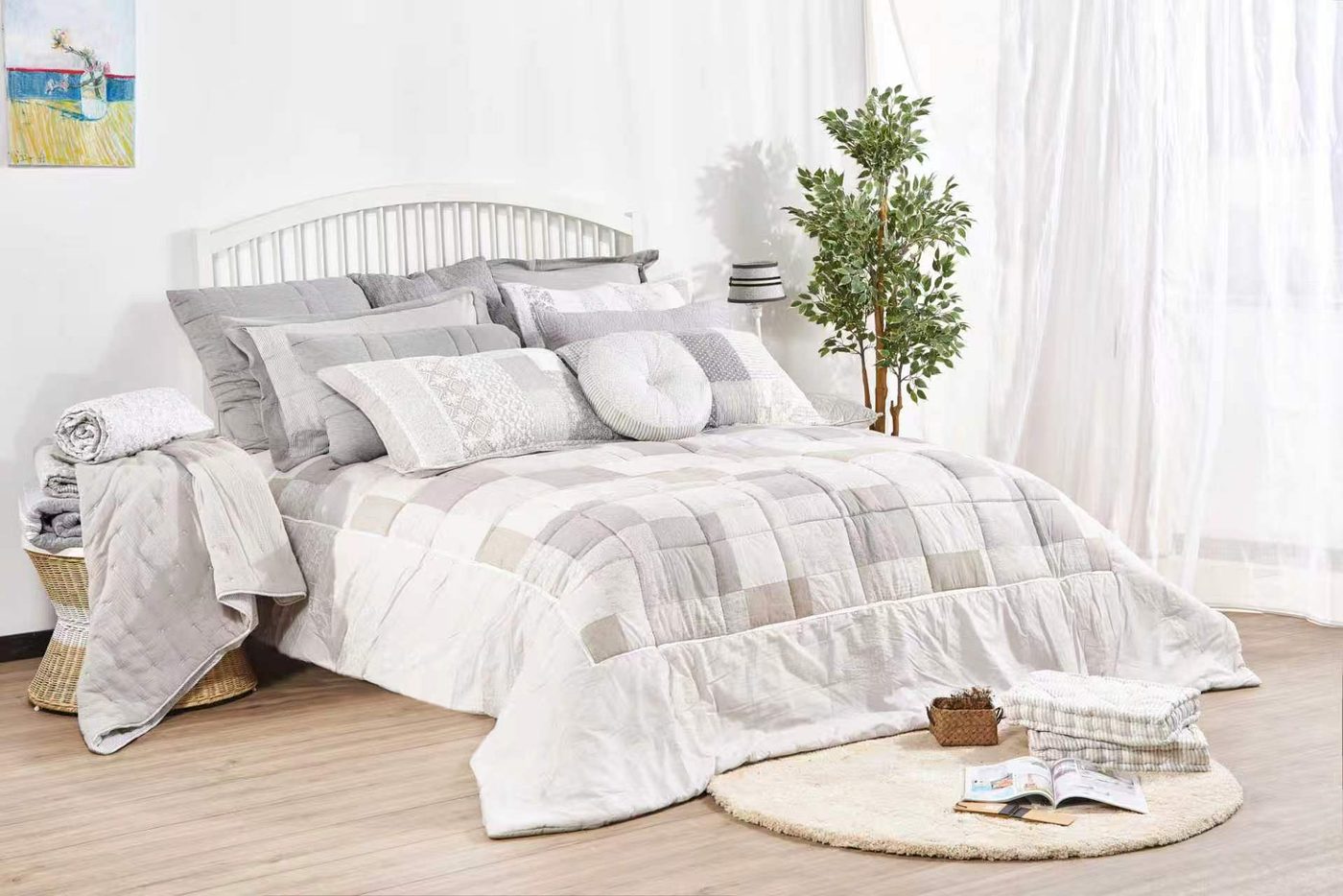
Specifying a textile without knowing the end use is how the wrong fill weight and the wrong construction get ordered. These are the real commercial applications.
| Application | What it demands of the specification |
|---|---|
| Retail bedding programmes | Coordinated quilt plus pillowcase sets sold through department and home stores on a seasonal calendar. |
| DTC e-commerce and marketplace listings | Single-unit retail with return rates that punish fill migration and size tolerance drift. |
| Hospitality and serviced apartments | Repeat replacement runs where the second order must match the first physically, not just visually. |
| Gift and seasonal promotions | Lower fill weight, printed shell, retail carton — the entry price point of the category. |
| Cold-climate and winter ranges | Higher fill weight, down or high-loft microfibre, often sold with a tog or GSM rating. |
We quote by construction — yarn count, grams per square metre, weave — not by marketing name. If you have a reference product, send it and we will reverse the construction.
| Material | Typical specification | Notes |
|---|---|---|
| Shell — cotton | 100% cotton, typically 40s–60s yarn count, 110–145 GSM | Standard breathable retail specification |
| Shell — poly-cotton | 65/35 or 50/50 polyester-cotton, 90–120 GSM | Lower cost, better dimensional stability, common in volume programmes |
| Shell — microfibre | 100% polyester peach-skin microfibre, 70–100 GSM | Soft hand-feel, strong colour fastness |
| Shell — brushed / flannel | Cotton or poly-cotton, brushed both faces, 130–180 GSM | Winter retail, warmth perception |
| Filling — polyester | Recycled or virgin hollow-fibre / siliconised ball fibre | Highest volume fill; weight set by GSM |
| Filling — microfibre | Fine-denier microfibre fill | Smoother hand-feel than standard hollow fibre |
| Filling — down & feather | Duck or goose down, typically 70/30 to 90/10 | Premium positioning; requires fill-power specification |
| Filling — silk | Mulberry silk floss or silk wadding | Lightweight, high-value, mostly Japan and premium EU |
| Filling — latex | Moulded or shredded natural latex | High resilience; our latex moulding is run in-house |
Commercial decisions live in these figures, not in adjectives. Where a number depends on your specification we say so rather than publishing a figure we have not confirmed.
| Parameter | Range / value |
|---|---|
| Fill weight | Typical range 150 – 600 GSM |
| Standard sizes | Single / Double / Queen / King / EU-standard, or your own dimension |
| Size tolerance | Typically ±2 cm on finished dimensions |
| Quilting stitch density | Box, diamond, channel or straight-line; pitch agreed per design |
| Shell yarn count | 40s / 50s / 60s cotton or specified blend |
| Certification available | ISO 9001:2015 (factory level, no. 1325Q10284R5S) |
| MOQ / lead time | Confirmed against your specification at quotation |
Size · fill weight (GSM) · fill material · shell fabric and yarn count · quilting pattern and stitch pitch · colour to Pantone · edge and closure finish · label and packaging
Spec sheet, drawing, or the physical reference produc>.
Built at the exact fabric and fill weight we intend to run.
Written approval on a sealed sample before any bulk production.
Carton engineering at packing. Loading from Ningbo and Shanghai.
Static demo — the live site posts to our CRM.
Each answer starts with the answer, then explains — written to be read by a person and quotable by a search engine.
A duvet is a filled bag — usually an insert that goes inside a separate cover. A quilt is a finished, quilted product with the filling stitched in place, normally used without a cover. A quilt is a retail product; a duvet is often a component.
Start from the market and the season, not from the price. Summer retail in Southern Europe is typically 150–250 GSM; all-season Northern European retail is 300–400 GSM; winter or cold-climate product starts at 400 GSM and rises. Send the market and we will propose a band.
Yes — send the specification or the physical reference product and we will reverse the construction. We build a counter-sample at the exact fill weight rather than a 'similar' one.
Yes. Latex moulding runs on our own floor, which means the fill distribution and the resilience are set by us rather than bought in from a third party.
Market-standard sizes for any region, or your own dimension. Tolerances are agreed and written into the golden sample rather than left to 'approximately'.
Our facility holds ISO 9001:2015. We do not currently hold an OEKO-TEX certificate original, so we do not claim it on this site. If your market requires it, tell us at the specification stage — it can be commissioned, but it must be priced into the quotation rather than discovered at customs.
Mixed containers across categories are the normal case, not a special request.