The sub-health segment in textile form. Consumers here buy an outcome rather than a product — and the technical risk sits almost entirely in fill distribution.
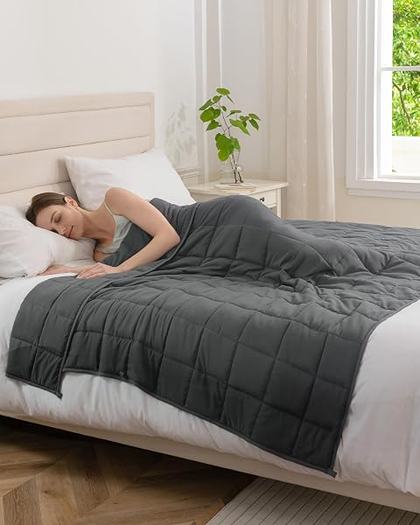
A weighted blanket is a quilted textile with dense filling distributed in a grid of pockets, so that the finished item exerts a defined, even pressure. The engineering problem is not the filling material — it is preventing that filling migrating and pooling, particularly through washing. Compartment topology and stitch integrity are the whole specification.
Specifying a textile without knowing the end use is how the wrong fill weight and the wrong construction get ordered. These are the real commercial applications.
| Application | What it demands of the specification |
|---|---|
| Sleep and stress retail | Consumer wellness positioning sold through marketplaces, DTC and specialist sleep retail. |
| Recovery and sensory support | Weighted lap pads and blankets for occupational-therapy and sensory contexts. |
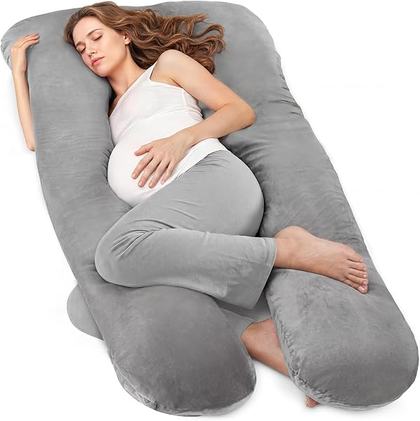
| Full-body support sleeping | U-form and J-form body pillows for side sleepers and pressure relief. |
| Maternity and post-natal | Pregnancy and nursing support formats. |
| Hotels and retreats | Premium wellness accoutrement in spa and retreat properties. |
We quote by construction — yarn count, grams per square metre, weave — not by marketing name. If you have a reference product, send it and we will reverse the construction.
| Material | Typical specification | Notes |
|---|---|---|
| Shell — cotton | 100% cotton, 200–280 GSM | Breathable; used where heat build-up is the concern |
| Shell — poly-cotton | 50/50 or 65/35, 180–240 GSM | Lower cost, better dimensional stability under load |
| Shell — microfibre / minky | Brushed polyester, 220–300 GSM | Soft tactile face, common in DTC positioning |
| Shell — bamboo viscose | Bamboo viscose / cotton blend | Moisture management, cool touch |
| Fill — glass microbead | Fine glass microbeads 0.5–1.5 mm | Dense, quiet, low bulk — the premium standard |
| Fill — poly pellet | Polyethylene pellets | Lower cost; noisier and bulkier for the same weight |
| Fill — steel shot | Fine steel micro-shot | Highest density; used where minimal bulk is required |
| Fill — layered fibre plus bead | Bonded polyester fibre with bead layer | Softer hand-feel at lower overall density |
Commercial decisions live in these figures, not in adjectives. Where a number depends on your specification we say so rather than publishing a figure we have not confirmed.
| Parameter | Range / value |
|---|---|
| Blanket weight | Typically 4.5 / 6.8 / 9 / 11 kg, commonly sized at ~10% of body weight |
| Filling — micro glass bead | Fine glass microbeads, typically 0.5–1.5 mm |
| Filling — plastic bead / steel shot | Poly pellets or steel |
| Filling — layered | Layered fibre plus bead |
| Compartment topology | Grid pockets, typically 10×10 cm to 15×15 cm |
| Shell | Cotton / poly-cotton / microfibre / bamboo viscose / minky |
| Washability | Machine washable where compartment construction permits |
| Certification | ISO 9001:2015 no. 1325Q10284R5S (factory) |
| MOQ / lead time | Confirmed against your specification at quotation |
Size · weight and weight distribution · fill material · compartment topology · shell fabric and colour · reversible construction · cover system · retail packaging
Spec sheet, drawing, or the physical reference product.
Built at the exact fabric and fill weight we intend to run.
Written approval on a sealed sample before any bulk production.
Carton engineering at packing. Loading from Ningbo and Shanghai.
Static demo — the live site posts to our CRM.
Each answer starts with the answer, then explains — written to be read by a person and quotable by a search engine.
Fill migration. Beads collect in one corner or one compartment after repeated use and washing, leaving the rest of the blanket light. The fix is compartment topology — smaller pockets mean less distance for the fill to travel — plus seam construction that survives the load. This is the single engineering problem in the category.
Glass microbeads are denser, quieter and lower-bulk, so a glass-filled blanket needs less fill volume for the same overall weight. Plastic pellets cost less but are noisier and bulkier. For retail at a premium price point, glass is the usual specification.
The widely used consumer convention is roughly 10% of the user's body weight. We manufacture to the weight you specify rather than the convention, because the practical variable is weight per unit area, which is what the user actually feels.
Where compartment construction permits, yes — but we test this at the sealed sample stage rather than asserting it. Some shell and fill combinations cannot survive domestic laundering, and the buyer needs to know that before the product goes to retail rather than after.
No. We manufacture the textile. Any therapeutic, medical or anxiety-treatment claim belongs to the brand making it and requires its own regulatory and testing pathway. We will say this plainly at the quotation stage.
U-form wraps the body and supports both sides, commonly used in pregnancy and side-sleeping. J-form is a cost-efficient partial wrap for side sleepers who need hip and knee separation without a full enclosure.
Mixed containers across categories are the normal case, not a special request.